

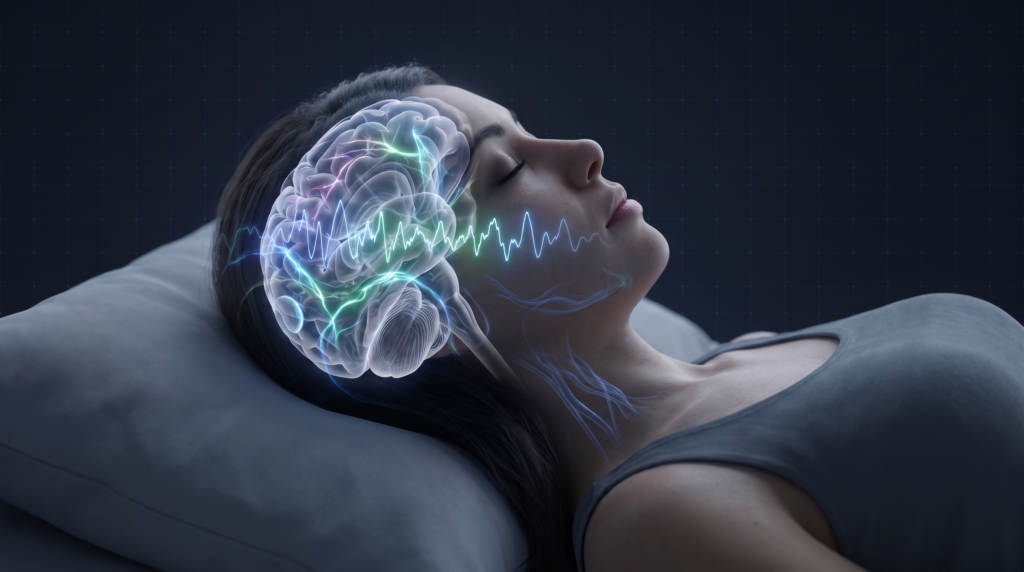
Can an ultrasound sleep patch improve REM sleep? In a small 2026 study, a wearable research device increased the proportion of the night spent in rapid eye movement (REM) sleep and shortened the time it took participants to reach REM. The findings are promising, but they do not show that the patch improves health, treats insomnia or is ready for home use.
The device, called NEUSLeeP, made headlines because it combines sleep monitoring with focused ultrasound aimed at a deep part of the brain. That sounds like a major leap. It may become one, but the most useful question today is not whether everyone will soon sleep wearing an ultrasound patch. It is what this early study actually found, what it did not test and what it teaches us about REM sleep.
Evidence checked: 17 August 2026. This explainer is based on the peer-reviewed study, the university’s research summary and public-health sleep guidance.
The study at a glance
- Published: 4 June 2026 in Nature Communications.
- Participants: 28 adults aged 19 to 38, with usable overnight results from 26.
- Study design: two consecutive nights, with sham stimulation on the first night and focused ultrasound on the second.
- Main result: REM sleep rose from 16.3% to 20.9% of total sleep time, a 4.6 percentage-point increase equal to about 16 extra minutes on average.
- REM timing: the average time to first REM sleep fell by about 43 minutes.
- Important limit: the study was small, single-blinded, used a fixed order and was not a double-blind, randomised trial with a parallel control group.
What is the NEUSLeeP ultrasound sleep patch?
NEUSLeeP stands for Non-invasive Electrophysiological Recording and Ultrasound Neuromodulation Sleep Patch. It is a flexible, skin-attached research device developed by a University of Texas at Austin-led team.
The patch has two jobs. First, it records electrical signals associated with sleep, including brain activity, eye movements and muscle activity. Second, it delivers low-intensity focused ultrasound towards the left subthalamic nucleus, a deep brain structure involved in networks linked with movement, emotion, arousal and sleep regulation.
The researchers designed the device to stay attached while someone sleeps and to target deeper brain tissue more precisely than surface electrical or magnetic stimulation normally can. This ability to monitor sleep and stimulate a selected region at the same time is the real technological advance.
What did the 2026 REM sleep study find?
The researchers recruited 16 participants they classified as healthy sleepers and 12 with poorer sleep scores. Two recordings were excluded because the signal was too noisy, leaving usable data from 15 healthy sleepers and 11 people in the poorer-sleep group.
Across those 26 participants, REM sleep increased from an average of 16.3% of total sleep time during the sham night to 20.9% during the active ultrasound night. The paper reports that as a 4.6% increase, but it is clearer to describe it as 4.6 percentage points. In time, it was about 15.9 additional minutes of REM sleep on average.
The average REM latency, meaning the time from falling asleep to the first REM period, fell from about 177 minutes to 135 minutes. The reduction was clearer in the healthy-sleeper group than in the poorer-sleep group.
The researchers did not find significant changes in overall sleep efficiency, the number of wake arousals or the proportion of other sleep stages. They also reported short-term changes in heart-rate variability in the healthy group and brain-imaging signals consistent with effects on targeted networks.
These are measurements of sleep architecture and physiology. The study did not show that participants felt better, remembered more, recovered faster or experienced a lasting improvement in mental health.
Why is REM sleep important?
REM is one of the two main types of sleep. Brain activity becomes more similar to wakefulness, the eyes move rapidly and vivid dreaming is common. REM periods tend to become longer later in the night, which is one reason a shortened night can remove a disproportionate amount of REM sleep.
REM sleep is associated with memory, learning, emotional processing and adaptation to stress. That does not mean that more REM is automatically better. Healthy sleep depends on moving through an organised pattern of REM and non-REM stages, not maximising one number in isolation.
For a broader explanation, read REM sleep explained and our guide to the four stages of sleep.
Why the result needs careful interpretation
The result is interesting because it suggests that non-invasive, targeted brain stimulation during natural sleep is technically possible. It is not yet strong evidence for a treatment. Several features of the study matter.
It was a small, young sample
The participants were aged 19 to 38, and only 26 produced usable overnight data. We cannot assume the same results would appear in older adults, people with diagnosed sleep disorders or the wider population.
Everyone had the nights in the same order
Every participant had sham stimulation on the first night and active stimulation on the second. People often sleep differently on a first night in a laboratory. Normal night-to-night variation, becoming more familiar with the setting or expecting the active treatment could therefore have influenced the result.
It was not double-blinded
The researchers state that the study was single-blinded and lacked a parallel control group. Without a double-blind, randomised and properly counterbalanced sham comparison, placebo, context and order effects cannot be ruled out.
It measured sleep stages, not health outcomes
The study measured REM timing and duration. It was not designed to prove that the patch treats insomnia, depression, anxiety or post-traumatic stress disorder. Nor did it establish that increasing REM by this amount produces better memory, mood or daytime performance.
Long-term safety and benefit remain unknown
Participants were monitored during the sessions and contacted one week later. That is useful early safety information, but it cannot establish the effects of repeated or long-term use. Larger, longer, independently replicated trials are needed.
Is the ultrasound sleep patch available to buy?
No. NEUSLeeP is a research prototype, not an established consumer sleep product or an approved treatment for insomnia. The university says the team has filed a patent application and is exploring commercialisation, but that is different from demonstrating clinical benefit or making the device available for safe home use.
People should not try to recreate brain-stimulation methods or use unregulated devices to change their sleep stages. Persistent sleep problems need proper assessment, especially when they involve loud snoring, gasping, breathing pauses, acting out dreams or severe daytime sleepiness.
What can you do for healthy REM sleep now?
You do not need to target REM directly. The practical aim is to give your brain enough uninterrupted time to complete a normal sequence of sleep cycles.
- Allow enough time for sleep. Most healthy adults need around seven to nine hours, although individual needs vary.
- Keep a reasonably consistent schedule. Regular sleep and wake times help the body anticipate when sleep should happen.
- Protect the second half of the night. REM periods usually lengthen towards morning, so repeatedly cutting sleep short can reduce them.
- Reduce avoidable disruption. Noise, excess heat, light, pain and physical discomfort can all fragment sleep. See the science behind uninterrupted sleep.
- Look beyond a wearable score. Consumer sleep trackers estimate stages and are not a substitute for a clinical sleep study.
- Ask for help when a problem persists. Speak to a GP if poor sleep is affecting daily life or you have signs of a sleep disorder.
A mattress cannot create REM sleep or alter brain activity on command. It can, however, help remove physical barriers to continuous sleep by supporting the body, managing pressure and avoiding excessive heat. That is the practical thinking behind the HIGGYS Recovery Standard.
Frequently asked questions
Did the ultrasound patch cure insomnia?
No. The study reported changes in REM sleep measures over one active night. It did not test whether the device treats or cures clinically diagnosed insomnia.
How much extra REM sleep did participants get?
Across the 26 usable recordings, REM increased by 4.6 percentage points of total sleep time, equal to about 15.9 extra minutes on average. Results varied between individuals.
Does more REM sleep always mean better sleep?
No. Sleep health depends on duration, continuity, timing and a normal balance of REM and non-REM stages. A single stage score should not be treated as a target by itself.
Can a smartwatch tell me how much REM sleep I get?
Consumer wearables can estimate sleep stages, but they do not directly measure them with the full set of signals used in a clinical sleep study. Use trends as general information, not as a diagnosis.
What is the main takeaway from the study?
The study shows that a soft wearable device may be able to monitor sleep and target deep brain circuits non-invasively. Whether that becomes a safe, effective treatment will depend on larger, randomised, double-blind and longer-term trials.
References
- Tang KWK et al. Skin-attached bioadhesive patch enabling ultrasound deep brain stimulation and real-time electrophysiological monitoring for REM sleep enhancement. Nature Communications. 2026;17:5570. Read the open-access study.
- University of Texas at Austin. Get Better Sleep With Ultrasound Patch That Boosts REM Rest. 7 July 2026. Read the university summary.
- NHS Every Mind Matters. Sleep problems. Read NHS sleep guidance.
- National Heart, Lung, and Blood Institute. How Sleep Works. Read the NIH sleep overview.
This article is for general information only and is not a substitute for medical advice, diagnosis or treatment. If you have persistent sleep problems or concerns about your health, speak to a qualified healthcare professional.