

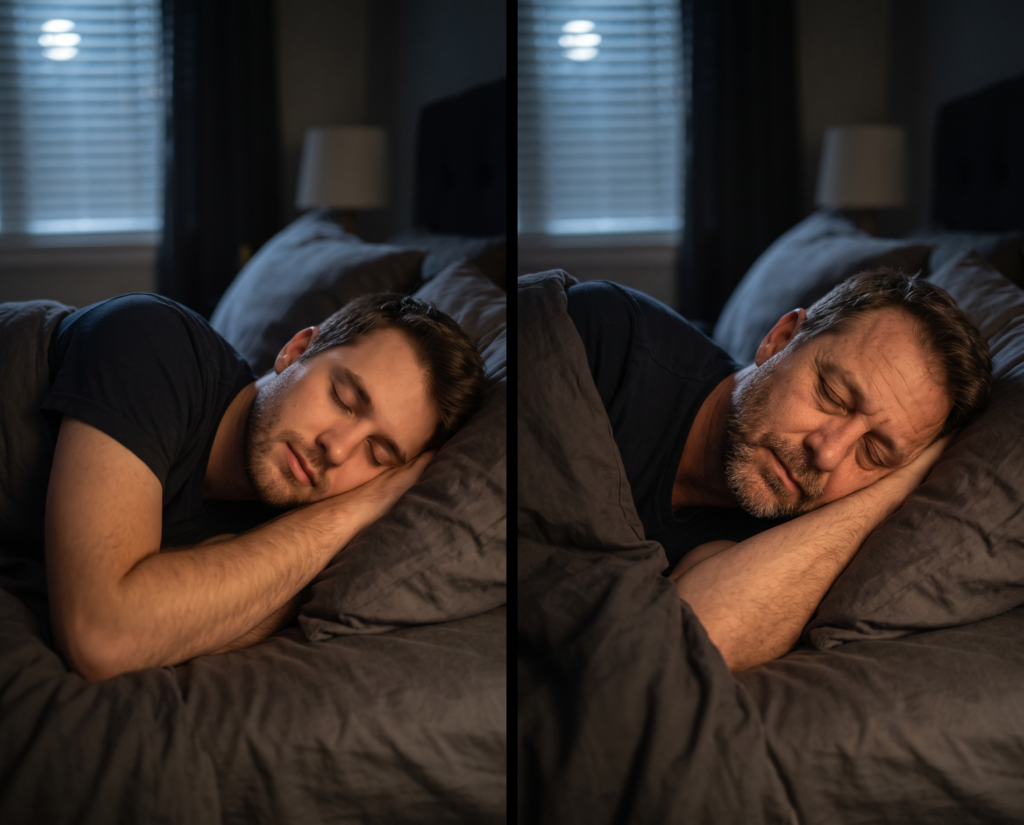
We often talk about sleep in terms of how we feel the next morning. Did we wake refreshed? Can we concentrate? Do our muscles feel recovered?
But sleep research is increasingly asking a bigger question: could the way we sleep also tell us something about how well our body and brain are ageing?
Several studies published in 2026 have added to that picture. One large analysis of UK Biobank data looked at sleep duration alongside biological ageing markers across the body. Another used brain activity recorded during sleep to estimate whether a person’s brain appeared biologically older or younger than their calendar age.
The findings are interesting, but they need to be read carefully. They do not prove that a particular number of hours will make you age more slowly. What they do show is that sleep appears to be closely connected with health across multiple systems, and that both too little sleep and unusually long sleep can sometimes be signs worth paying attention to.
What do scientists mean by biological age?
Your chronological age is simply the number of years you have been alive. Biological age is different. It is an attempt to estimate how old different systems in the body appear based on measurable features such as proteins, metabolites, imaging or patterns of brain activity.
Two people can be the same chronological age but have different health profiles. Researchers use biological ageing measures to study whether particular behaviours or conditions are associated with healthier or less healthy ageing patterns.
That does not mean there is one definitive biological age hidden inside you. Different measures look at different aspects of the body, and they are still primarily research tools rather than a score most people need to track at home.
What the 2026 Nature study found
A major study published in Nature in 2026 analysed data from the UK Biobank and compared self-reported sleep duration with 23 different biological ageing clocks derived from imaging, proteins and metabolites.
The researchers found a broadly U-shaped relationship. In other words, the lowest biological age gaps tended to appear in the middle, while both shorter and longer sleep were associated with less favourable ageing markers.
Across the measures that showed a significant relationship, the lowest biological age gaps appeared at sleep durations ranging from around 6.4 to 7.8 hours, depending on the organ system and sex being analysed.
That sounds precise, but it should not be treated as a new bedtime target.
The study used self-reported sleep duration, not a laboratory measurement of how long each person was actually asleep. It was also observational. It can show associations, but it cannot prove that sleeping a certain number of hours directly causes slower or faster ageing. The researchers also noted that reverse causality cannot be ruled out. In some cases, longer sleep may be a consequence or marker of underlying health problems rather than the cause of them.
So, is seven hours now the ‘perfect’ amount of sleep?
No. There is no single perfect number that applies to every adult.
The NHS says most healthy adults need around 7 to 9 hours of sleep a night, while also recognising that individual needs vary with age, health and daily routine.
That is an important distinction. Population studies are useful for identifying patterns, but they are not personalised prescriptions.
How you function during the day still matters. Waking reasonably refreshed, having enough energy to get through normal activities and being able to concentrate are useful signs that you may be getting enough sleep. Regular daytime sleepiness, difficulty waking, irritability or poor concentration can suggest that sleep is not meeting your needs.
Duration is also only one part of sleep health. Seven or eight hours spent repeatedly waking, overheating or struggling with discomfort is not the same as seven or eight hours of stable, restorative sleep.
That is why sleep quality, continuity and the conditions that allow normal sleep cycles to happen matter alongside the clock.
Your sleeping brain may also reveal how it is ageing
Another 2026 study, published in JAMA Network Open, looked at brain activity recorded during overnight sleep studies in 7,105 adults from five long-term research cohorts.
The researchers used machine learning to calculate a ‘brain age index’ from detailed patterns in sleep electroencephalography, or EEG. They then compared that estimated brain age with each participant’s chronological age.
A higher brain age index was associated with a higher risk of developing dementia during follow-up. Across the cohorts, every 10-year increase in the brain age index was associated with a 39% higher risk of incident dementia before further adjustment for some additional health and genetic factors.
Again, this does not mean that a poor night of sleep ages your brain by ten years, and it does not mean that a sleep tracker can tell you your dementia risk.
The study was looking at complex EEG signals collected during formal sleep studies. The researchers described brain age as a potential prognostic marker, not a direct treatment target, and they were clear that the observational data cannot establish cause and effect.
What it does reinforce is the idea that sleep contains information about brain health that may be more meaningful than simply counting the hours spent in bed.
Why sleep and recovery are so closely connected
Sleep gives the body the opportunity to move through organised stages that support different aspects of recovery. Deep sleep is associated with physical restoration, while other sleep stages contribute to memory, learning, emotional processing and normal brain function.
When sleep is repeatedly shortened or fragmented, those processes have less opportunity to run normally. This helps explain why researchers are increasingly studying sleep alongside cardiovascular health, metabolism, immunity, cognition and ageing rather than treating it as an isolated behaviour.
At HIGGYS, we describe this as creating the right conditions for recovery. A mattress cannot guarantee deep sleep or change your biological age. What it can do is remove avoidable barriers such as poor spinal support, pressure discomfort and excess heat that may otherwise contribute to disturbed sleep.
If you want to understand more about the stages involved, read our guides to how deep sleep helps the body recover and the science behind uninterrupted sleep.
Consistency may matter as well as duration
Newer research is also looking beyond the total number of hours slept.
A 2026 study in the Journal of Behavioral Medicine examined daily routines in a small group of older adults, including people with insomnia. More regular timings for activities such as waking, eating, socialising and going to bed were associated with lower levels of pain and depressive symptoms.
Because the study was small, it should not be overinterpreted. But it fits with a broader understanding of circadian biology: the body responds to regular timing cues, and large day-to-day changes can make it harder for the internal body clock to stay aligned.
For most people, this means that improving sleep is not only about going to bed earlier. A reasonably consistent wake time and daily routine can also help create more predictable conditions for sleep.
What should you do with this research?
You do not need to measure your biological age or obsess over a perfect sleep score. The practical message is much simpler:
- Aim for enough sleep for you. For most healthy adults, the NHS suggests around 7 to 9 hours.
- Pay attention to daytime function. Feeling persistently exhausted despite spending enough time in bed is worth investigating.
- Protect sleep continuity. Repeated waking caused by heat, discomfort, noise or other disturbances can reduce the quality of the night.
- Keep your routine reasonably consistent. Similar wake and sleep times can help support the body’s natural timing system.
- Do not ignore persistent sleep problems. Loud snoring, gasping during sleep, ongoing insomnia or excessive daytime sleepiness can be signs that it is worth speaking to a GP or sleep professional.
The bigger message: sleep is not lost time
The most useful thing about this new research is not the suggestion that one precise sleep duration might be associated with younger biological markers.
It is the growing evidence that sleep is connected with health throughout the body.
Good sleep supports recovery today, but it may also provide researchers with an increasingly useful window into long-term health. That makes sleep something worth protecting, not because of a headline about living longer, but because it is one of the fundamental conditions the body needs to function and recover properly.
Start with the basics: enough time for sleep, a consistent routine, a comfortable sleep environment and professional advice when something does not feel right.
References
- MULTI Consortium, Sleep chart of biological ageing clocks in middle and late life, Nature, 2026. View research.
- Sun H et al., Machine Learning-Based Sleep Electroencephalographic Brain Age Index and Dementia Risk, JAMA Network Open, 2026. View research.
- NHS Every Mind Matters, Sleep problems. Read NHS guidance.
- Tracy EL et al., Behavioral-social rhythms and insomnia symptoms: associations with pain, body mass index, and depressive symptoms among older adults, Journal of Behavioral Medicine, 2026.
This article is for general information only and is not a substitute for medical advice. If you have persistent sleep problems or concerns about your health, speak to a qualified healthcare professional.