

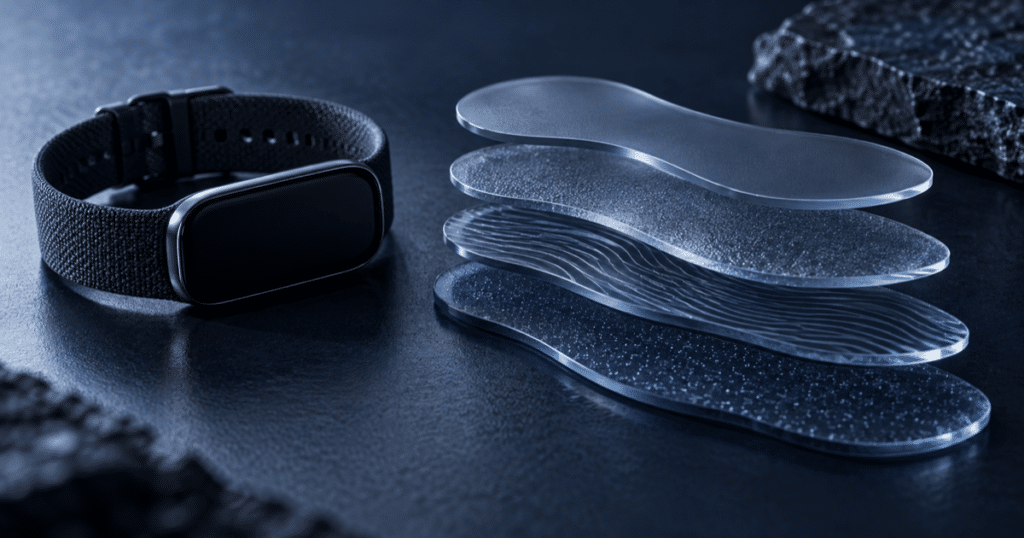
Can a sleep tracker really measure REM and deep sleep? A wrist device can estimate sleep stages from movement and other signals, but it does not measure them as directly as a clinical sleep study. A major 2026 study shows why these estimates can still be valuable for research across thousands of people. It does not turn a nightly wearable score into a diagnosis or a personal forecast of future disease.
The new research analysed wrist accelerometer data from 95,559 UK Biobank participants. The researchers used a machine learning system to estimate sleep stages, duration, irregularity and time awake after sleep began. They then looked for associations with new hospital diagnoses over a median follow-up of 8.9 years.
Evidence checked: 28 September 2026. This article is based on the peer-reviewed PLOS Medicine study published on 17 September 2026, current NHS sleep guidance and professional guidance on consumer sleep technology.
The sleep tracker study at a glance
- Participants: 95,559 middle-aged and older adults in UK Biobank.
- Measurement: about seven days of movement data from a research wrist accelerometer.
- Analysis: a machine learning method called SleepNet estimated REM, light and deep sleep, total sleep duration, irregularity and wakefulness after sleep onset.
- Follow-up: a median of 8.9 years, using linked inpatient health records.
- Main finding: the analysis found 156 statistically significant associations between sleep patterns and incident disease phenotypes after the study’s strict correction.
- Main limit: this was an observational study using movement-based estimates, so it cannot show that a particular sleep stage caused or prevented disease.
What did the 2026 study find?
The researchers compared six aspects of sleep with 1,049 health outcomes. After applying a strict correction for the large number of comparisons, they reported 97 associations involving estimated sleep stages, 50 involving total sleep duration, six involving time awake after sleep began and three involving sleep irregularity.
More estimated REM sleep was associated with lower risk across 83 outcomes. More estimated deep sleep was associated with lower risk across seven. Very short sleep, defined as less than five hours, showed the broadest pattern of adverse associations when compared with six to eight hours.
Those numbers sound dramatic, but association is the important word. Sleep can influence health, while health conditions, medicines, pain, breathing problems, lifestyle and social circumstances can also influence sleep. Statistical adjustment can reduce some of that noise, but it cannot remove every difference between people.
The findings therefore create a useful map for further research. They do not prove that adding a set number of REM minutes will prevent a named condition, or that a low score on one night reveals disease.
How did a wrist sensor estimate sleep stages?
A clinical overnight sleep study, called polysomnography, measures signals including brain activity, eye movements and muscle activity. These signals allow trained specialists and validated systems to identify sleep stages more directly.
The UK Biobank device mainly recorded movement. SleepNet had previously learned patterns that tend to occur alongside sleep stages by comparing wrist accelerometer data with laboratory sleep studies. It then used those learned relationships to estimate stages in the much larger Biobank group.
That approach makes large, real-world studies possible. Bringing nearly 100,000 people into a sleep laboratory would be impractical. A wearable can capture ordinary nights at home and reveal population patterns that a small laboratory experiment may miss.
The trade-off is precision. The study authors describe agreement with gold-standard polysomnography as relatively modest. Their stage values are movement-based estimates and may not fully match biological sleep stages.
Does this validate your smartwatch sleep score?
No. The study used a particular research accelerometer, a particular algorithm and a population-level analysis. Consumer watches and rings may combine movement, pulse and other signals, but their algorithms differ by brand, model and software version. Many are proprietary, so an apparently similar label such as “deep sleep” may be calculated differently.
A wearable may still help you notice broad patterns. You might see that your estimated sleep duration changes when your schedule shifts, or that repeated late nights shorten your sleep opportunity. Trends across several weeks are usually more useful than reacting to one stage score.
It is less useful to chase an ideal percentage of REM or deep sleep. Stage estimates can vary because of normal night-to-night differences, device fit, movement, software updates and the limits of the algorithm. Worrying about the number can also make sleep feel like a performance test.
Consumer sleep technology should not be used to diagnose or treat a sleep disorder. If symptoms and a device disagree, symptoms still deserve attention. Persistent insomnia, severe daytime sleepiness, loud snoring, gasping or witnessed pauses in breathing need proper clinical assessment.
Why the study does not change the usual sleep advice
The paper found that the lowest statistical risk for many outcomes was concentrated between six and eight hours in this particular analysis. That should not be turned into a new six-hour target. The NHS advises that most healthy adults need around seven to nine hours, while individual needs vary.
The participants were not a perfect picture of the whole UK population. Their mean age was 56, 96.9 per cent identified as white and people who volunteer for UK Biobank tend to be healthier than the general population. Sleep was estimated from one recording period rather than continuously across the full follow-up.
The practical message is broader than one ideal number. Give yourself enough opportunity to sleep, keep timing reasonably consistent, reduce avoidable disturbance and pay attention to how you function during the day.
For a clearer explanation of the night itself, read our guides to the four stages of sleep, REM sleep and deep sleep.
How to use sleep tracker data without letting it run your night
- Look for patterns, not verdicts: compare several weeks rather than treating one night’s score as a judgement.
- Start with sleep opportunity: a tracker cannot find eight hours of sleep inside six hours in bed.
- Use daytime function as context: notice whether you feel refreshed, can concentrate and can stay awake safely.
- Do not optimise one stage: healthy sleep depends on duration, timing, continuity and cycling through stages.
- Reduce obvious disruption: address excess heat, light, noise and physical discomfort where you can.
- Seek help for symptoms: take persistent problems to a GP rather than waiting for a device to confirm them.
What does this mean for the sleep environment?
A mattress cannot manufacture REM sleep, increase deep sleep on command or change a disease risk score. It can only influence part of the environment in which sleep happens.
That is still useful when claims stay proportionate. Appropriate support, pressure relief and temperature control may reduce avoidable physical discomfort and overheating that interrupt sleep. They do not replace enough time in bed, regular habits or clinical care.
The HIGGYS Sleep Health Hub brings those factors together without asking one wearable number to explain the whole night.
Frequently asked questions about sleep trackers and sleep stages
Can a sleep tracker accurately measure REM sleep?
A wrist tracker estimates REM sleep from indirect signals such as movement and pulse. Accuracy varies by device and algorithm. A clinical sleep study measures brain, eye and muscle activity and remains the more direct method for identifying sleep stages.
What is a good deep sleep score?
There is no single consumer tracker target that everyone should chase. Sleep stages vary with age, circumstances and normal night-to-night change, while device estimates also vary. Focus on adequate opportunity, regularity and daytime wellbeing.
Did the study prove that more REM prevents disease?
No. Greater estimated REM sleep was associated with lower risk across many outcomes, but the observational design cannot prove cause and effect. Illness and other unmeasured factors may influence both sleep and later diagnoses.
Should I worry about one bad sleep score?
Usually not. One score can reflect a genuinely disrupted night, normal variation or measurement error. Look at longer patterns and how you feel. Speak to a GP if poor sleep persists or affects daily life.
Can a tracker diagnose sleep apnoea or insomnia?
A general consumer sleep score cannot diagnose either condition. Some regulated devices have specific screening functions, but diagnosis still requires appropriate clinical evaluation. Seek advice for persistent insomnia, loud snoring, gasping, breathing pauses or excessive daytime sleepiness.
Can a mattress improve my tracker score?
A suitable mattress may reduce discomfort, poor support or excess heat that disturbs sleep, but it cannot guarantee a higher score or directly change sleep stages. Judge a sleep surface by comfort, support and whether it suits your needs, not by a promised wearable result.
References
- Luo J, Liu R, Yin J, Cao W, Sun S, Chen R. Accelerometer-derived real-world sleep stages and risk of incident diseases: A UK Biobank cohort study and phenome-wide association analysis. PLOS Medicine. 2026;23(9):e1005213. DOI: 10.1371/journal.pmed.1005213. Read the peer-reviewed study.
- NHS Every Mind Matters. Sleep problems. Read NHS guidance.
- NHS. Insomnia. Read NHS guidance.
- Khosla S et al. Consumer sleep technology: an American Academy of Sleep Medicine position statement. Journal of Clinical Sleep Medicine. 2018;14(5):877-880. Read the position statement.
This article is for general information only and is not a substitute for medical advice, diagnosis or treatment. Speak to a GP if sleep problems persist, affect daily life or involve loud snoring, gasping, breathing pauses or excessive daytime sleepiness.