

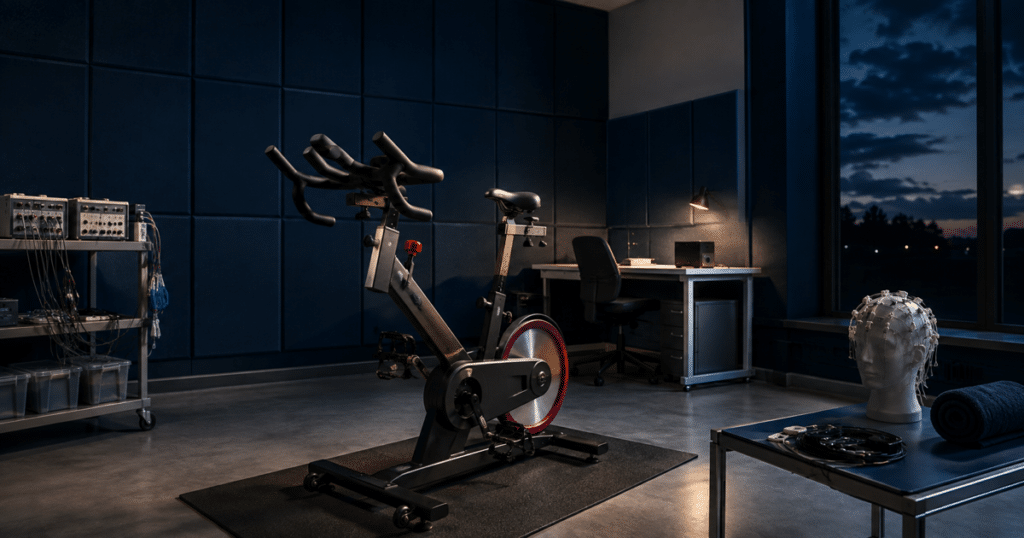
Can exercise after sleep loss protect memory? A new laboratory study found that healthy young adults who completed 30 minutes of moderate evening cycling before a deliberately short night performed better on a face-name memory test the next morning than those who had the same short sleep without exercise. The result is promising, but it does not show that exercise can replace enough sleep.
The study helps explain how movement and sleep may work together. It also shows why a striking result needs careful limits. The researchers tested one type of exercise, one memory task and one night of restricted sleep in a closely screened group. They did not test chronic sleep loss, daytime safety or whether a workout reverses every effect of a bad night.
Evidence checked: 7 September 2026. This explainer is based on the peer-reviewed accepted manuscript published in SLEEP on 26 August 2026, the open-access full paper and current NHS guidance on sleep and physical activity.
The exercise, short sleep and memory study at a glance
- Study design: a randomised, four-group, between-subjects laboratory experiment.
- Participants analysed: 88 healthy adults aged 18 to 35, with an average age of 24; 52 per cent were female.
- Exercise: 30 minutes of supervised stationary cycling at 55 to 60 per cent of each participant’s measured maximum oxygen uptake, plus a warm-up and cool-down.
- Sleep opportunities: either 8.5 hours, from 11 pm to 7.30 am, or 4.5 hours, from 3 am to 7.30 am.
- Memory test: participants learned 80 face-name pairs before sleep and completed a delayed recognition test the next morning.
- Main result: the exercise plus short-sleep group performed better at delayed recognition than the short-sleep-only group.
- Possible pathway: the proportion of slow-wave sleep statistically mediated part of the association.
- Important limit: one controlled night in healthy young adults cannot establish a remedy for repeated sleep loss or a clinical treatment.
How did the researchers test exercise after sleep loss?
The investigators recruited 92 adults and analysed data from 88. Participants were healthy, described as good sleepers and underwent an initial laboratory sleep study to screen out sleep disorders. People with current or previous sleep, psychological, neurological or other medical conditions were excluded, as were shift workers and people with obesity.
Participants were randomly allocated to one of four conditions:
- 8.5 hours of sleep without exercise;
- 4.5 hours of sleep without exercise;
- 8.5 hours of sleep after moderate exercise; or
- 4.5 hours of sleep after moderate exercise.
The exercise groups cycled at 7 pm. The main 30-minute session was individualised using a fitness test and monitored by heart rate. The comparison groups spent the same 40-minute period seated quietly. At 10 pm, everyone learned 80 face-name pairs and then completed an immediate test.
The normal-sleep groups went to bed at 11 pm. The restricted-sleep groups stayed awake in the laboratory until 3 am, then slept until 7.30 am. Electrodes measured their sleep stages, eye movements and heart activity. At 8.30 am, everyone completed the delayed memory test.
What did the memory test show?
Immediate memory performance was similar across the four groups. The meaningful difference appeared the next morning. Participants who exercised before the short sleep performed significantly better on delayed recognition than those who had short sleep without exercise.
The exercise plus short-sleep group was not statistically different from either full-sleep group on this test. That does not prove the groups were biologically equivalent or that exercise restored everything lost through sleep restriction. A non-significant difference can mean the study did not detect a difference in this sample. It is not proof that the two conditions have identical effects.
The reported exercise-by-sleep interaction had a p value of 0.033 and a partial eta squared of 0.056. The comparison between exercise plus short sleep and short sleep alone had a p value of 0.028 after adjustment for multiple comparisons. These figures support a real signal in the experiment, but the effect was measured on one specialised memory task rather than across everyday cognition.
Why might slow-wave sleep matter for memory?
Slow-wave sleep is the deepest stage of non-REM sleep. It is most concentrated in the first part of the night and is associated with the reorganisation and stabilisation of newly learned information. The restricted condition in this study removed much of that early-night sleep opportunity.
The analysis found that slow-wave sleep percentage statistically mediated the link between exercise and delayed memory performance. Stage N2 duration also appeared in the mediation analysis. This is compatible with the idea that exercise changed aspects of the sleep period that support memory.
However, statistical mediation does not prove a biological mechanism. The researchers ran several exploratory mediation and moderation tests, which increases the chance of a false-positive result. They describe these findings as hypothesis-generating and call for replication.
For a fuller explanation of this sleep stage, read what happens during deep sleep. Our guide to sleep deprivation explains why one test cannot capture every effect of a shortened night.
What the study does not prove
- Exercise is not a substitute for sleep. The study measured one memory outcome after one restricted night. It did not show normal mood, attention, reaction time, judgement, driving safety or physical recovery.
- The finding may not apply to everyone. The sample was young and healthy. Results may differ in older adults, children, shift workers or people with insomnia, sleep apnoea, obesity or other health conditions.
- It does not test repeated short sleep. Chronic sleep restriction can produce cumulative effects that one laboratory night cannot model.
- It does not identify a perfect workout. The researchers used supervised cycling at an individualised intensity. They did not compare walking, running, strength training or exercise at different times.
- It does not prove the exact mechanism. Slow-wave sleep percentage was a statistical mediator, but the study did not directly manipulate slow waves or prove that they alone caused the memory difference.
Should you exercise in the evening?
Regular physical activity is part of wider health guidance, but the timing that feels comfortable varies. In this experiment, cycling began at 7 pm and finished more than three hours before either bedtime. It was not a last-minute intense workout immediately before sleep.
The NHS advises people with insomnia to exercise regularly during the day and avoid exercise close to bedtime. If evening activity leaves you hot, alert or unable to settle, move it earlier. If you have a health condition, have been inactive for a long time or are unsure what intensity is safe, seek appropriate professional advice before changing your routine.
What should you do after a short night?
- Do not treat the study as permission to cut sleep. Most healthy adults need around seven to nine hours a night, although individual needs vary.
- Put safety first. Do not drive if you feel sleepy. A workout did not test or restore driving performance in this experiment.
- Use movement as one healthy behaviour. Moderate activity may be worthwhile if it is safe and suits you, but do not expect it to erase tiredness or replace recovery sleep.
- Protect the next sleep opportunity. Keep a consistent routine, leave enough time for sleep and avoid relying on late caffeine if it delays bedtime.
- Reduce avoidable disruption. A dark, quiet, comfortably cool room and a supportive sleep surface can help make the time available for sleep more stable.
- Get help for a pattern. Speak to a GP if poor sleep has lasted for months, affects daily life or comes with loud snoring, gasping, breathing pauses or severe daytime sleepiness.
Where does the mattress fit?
A mattress cannot improve memory directly, create slow-wave sleep or compensate for a short night. Its role is more practical. A suitable sleep surface can reduce physical barriers such as pressure discomfort, poor support and excess heat that may contribute to movement or waking.
This is the evidence-led distinction behind the HIGGYS Recovery Standard. Pressure relief, spinal alignment and temperature control are parts of the sleep environment. They support the conditions for comfortable, less disrupted sleep, but they do not replace sufficient time or treat a sleep disorder.
Read the science behind uninterrupted sleep for more on how sleep continuity matters alongside duration.
Frequently asked questions
Can exercise make up for lost sleep?
No. One study found better delayed face-name recognition after moderate evening exercise and one short night. It did not show that exercise restored every cognitive, emotional, metabolic or physical effect of insufficient sleep.
What exercise did the participants do?
They completed 30 minutes of supervised stationary cycling at 55 to 60 per cent of their measured maximum oxygen uptake, with a five-minute warm-up and a five-minute cool-down.
How little did the short-sleep groups sleep?
They had a 4.5-hour sleep opportunity from 3 am to 7.30 am. The full-sleep groups had an 8.5-hour opportunity from 11 pm to 7.30 am.
Did exercise increase deep sleep?
The proportion of slow-wave sleep was involved in the statistical mediation analysis, but the result should not be simplified to a guaranteed deep-sleep boost. The exploratory mechanism needs replication, and consumer trackers do not measure sleep stages as directly as laboratory brain-wave recording.
Is it safe to exercise after a bad night’s sleep?
That depends on the person, the activity and how sleepy they feel. Avoid tasks where fatigue could make a mistake dangerous, reduce intensity if needed and seek professional advice if you have symptoms or a condition that affects exercise safety.
Can a mattress improve memory?
A mattress is not a memory treatment. A suitable mattress may reduce physical discomfort, poor support or excess heat that disturbs sleep, but memory depends on many factors and still requires adequate sleep opportunity.
References
- Frimpong E et al. Slow-Wave Sleep Mediates the Compensatory Effects of Acute Moderate-Intensity Exercise on Declarative Memory Deficits in Sleep Restriction. SLEEP. Published online 26 August 2026. DOI: 10.1093/sleep/zsag235. View the journal record, read the accepted manuscript or view the PubMed record.
- NHS. Sleep problems. Read NHS sleep guidance.
- NHS. Insomnia. Read NHS insomnia guidance.
- NHS. Benefits of exercise. Read NHS physical-activity guidance.
This article is for general information only and is not a substitute for medical advice, diagnosis or treatment. If you have persistent sleep problems or concerns about your health or exercise safety, speak to a qualified healthcare professional.