

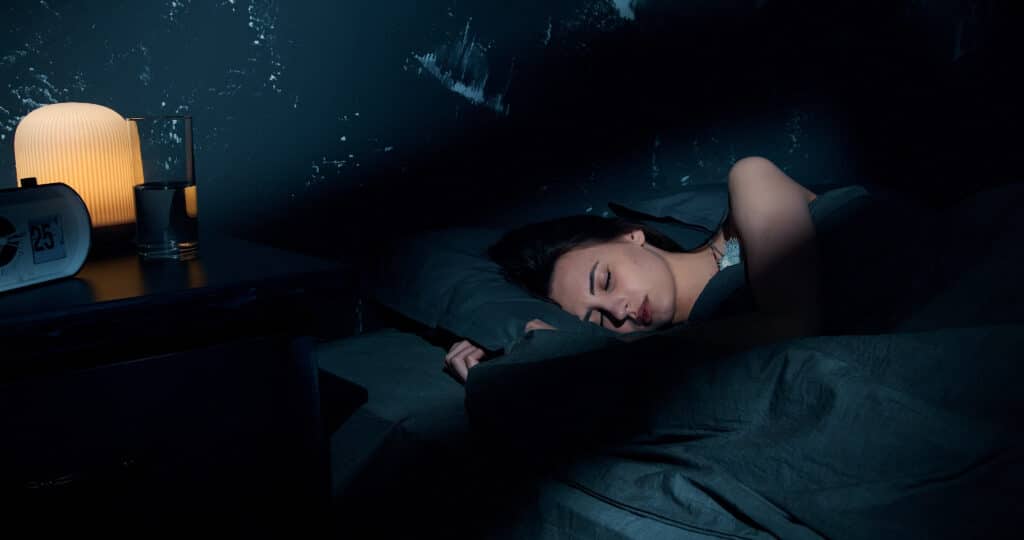
Most sleep advice treats sleep as a single block of time. It is not. Sleep runs in cycles, and the stages within those cycles do different jobs. Deep sleep, known clinically as slow wave sleep, is the stage that carries most of the physical repair load.
Understanding what happens in that stage matters, because it changes what you should be asking of a mattress. A surface that interrupts deep sleep is not a comfort problem. It is a recovery problem.
What is deep sleep?
Deep sleep is the stage of non REM sleep characterised by high amplitude, low frequency brain waves, reduced heart rate, lowered blood pressure and minimal muscle activity. It usually occupies the largest share of the first half of the night and is the hardest stage to be woken from.
Adults typically move through four to six sleep cycles per night, each lasting roughly 90 minutes. Early cycles are weighted towards deep sleep. Later cycles shift towards REM. This is why a night that is cut short at the front end and a night that is cut short at the back end damage different things.
The four stages in order
- N1: the transition from wake to sleep. Light, brief, easily interrupted.
- N2: the largest share of total sleep time. Body temperature falls, heart rate slows.
- N3: deep sleep, or slow wave sleep. The repair stage.
- REM: rapid eye movement sleep. Dreaming, memory consolidation, emotional processing.
Why is deep sleep called the repair stage?
Deep sleep is called the repair stage because the majority of the body’s overnight tissue repair activity is concentrated there. Research by Van Cauter and colleagues found that around 75 per cent of daily growth hormone release occurs during deep sleep. Growth hormone drives muscle repair, bone density maintenance and tissue regeneration.
That single figure reframes the whole conversation. If deep sleep is fragmented, the hormonal window for repair is fragmented with it.
Muscle repair
Work published by Lamon and colleagues in 2021 recorded an 18 per cent drop in muscle protein synthesis after a single night of restricted sleep. One night. Not a week of poor sleep, not chronic insomnia. One night was enough to produce a measurable reduction in the body’s rate of muscle repair.
Injury risk
The downstream effect is not theoretical. Data from athletic populations has repeatedly linked habitual sleep of under seven hours with roughly 1.7 times higher injury risk compared with those sleeping longer. Tissue that has not finished repairing is tissue that fails under load.
Brain clearance
Deep sleep is also when the brain’s clearance processes run at their highest rate. Research into the glymphatic system has shown that the flow of cerebrospinal fluid through brain tissue increases substantially during slow wave sleep, moving metabolic waste products out. A 2025 study reported in the sleep literature added further weight to the link between deep sleep and waste clearance in the brain.
How much deep sleep should you get?
Most healthy adults spend roughly 13 to 23 per cent of total sleep time in deep sleep, which works out at around one to two hours across a normal night. The share falls with age. It is also reduced by alcohol, late evening exercise, high bedroom temperature and frequent physical disturbance.
The important word there is disturbance. You do not need to wake fully to lose deep sleep. Brief arousals that never reach conscious awareness are enough to pull the brain up out of slow wave sleep and restart the cycle.
What disrupts deep sleep at night?
Three physical factors account for a large share of avoidable deep sleep disruption: heat, pressure and misalignment. Each produces micro arousals, each is measurable, and each is directly affected by the surface you sleep on.
Heat
Core body temperature has to fall for sleep to initiate and to stay deep. A sleep surface that traps heat works against that process all night. A 2023 actigraphy study published in Sleep Health found sleep efficiency was 3.4 per cent lower in the highest bedroom temperature exposure quintile compared with the lowest, with similar dose dependent effects for noise, carbon dioxide and fine particulate matter.
Pressure
When body weight concentrates at the hips, shoulders and heels, local pressure can restrict blood flow to the skin and underlying tissue. The body’s response is to shift position. Frequent repositioning through the night is a reliable sign that a surface is not managing pressure well.
The clinically referenced capillary closure threshold sits at around 32 mmHg. Independent pressure mapping of HIGGYS mattresses recorded an average contact pressure of 14.94 mmHg, less than half that threshold.
Misalignment
If the spine is held out of neutral for hours, supporting muscles stay partly engaged rather than releasing. That produces the familiar pattern of waking stiff after eight hours in bed. Independent testing recorded 6 per cent less body sink on HIGGYS compared with a VL memory foam comparator, which means less of the sagging that pulls the lumbar region out of line.
Does a mattress actually affect deep sleep?
A mattress cannot create deep sleep. It can only remove the physical reasons deep sleep gets interrupted. That is a narrower claim than most mattress marketing makes, and it is the only one worth making.
This is the logic behind the Recovery Standard, the engineering principle HIGGYS builds to. Every material has to demonstrate measurable performance in three areas: spinal alignment, pressure relief and temperature control. If a material cannot prove all three under test, it does not go into the product.
Healthcare Engineered Foam sits at the core of that system. It is designed for healthcare use and tested for pressure relief, spinal alignment, and temperature regulation. It is the same foam specified for healthcare mattresses and spinal injury beds, tested independently by SATRA. In SATRA testing it cooled 179 per cent faster than 75kg memory foam.
How do you tell if you are getting enough deep sleep?
The honest answer is that you cannot measure deep sleep accurately at home. Consumer wearables detect sleep versus wake reasonably well but misclassify sleep stages a large share of the time. A low deep sleep score on a wrist tracker is an estimate, not a measurement.
More reliable everyday signals include:
- Waking without the sensation of having been unconscious
- Persistent morning stiffness that eases within 30 minutes of getting up
- Needing more than 30 minutes to feel functional after waking
- Repeated night waking with no obvious cause such as noise or a full bladder
- Feeling hot or damp at the point of waking
None of these is diagnostic. All of them are worth taking seriously, and the first three are commonly reported by people whose sleep surface is working against them.
Frequently asked questions
Is deep sleep the same as REM sleep?
No. Deep sleep is stage N3 non REM sleep and handles most physical repair. REM sleep is a separate stage associated with dreaming, memory consolidation and emotional processing. Both are needed, and they occur at different points in the night.
Can you get more deep sleep?
You cannot force it directly, but you can remove what interrupts it. A consistent sleep and wake time, a bedroom between roughly 17 and 20 degrees, darkness, low noise and a surface that manages heat and pressure all raise the amount of uninterrupted slow wave sleep the body can take.
Does deep sleep decrease with age?
Yes. The proportion of time spent in slow wave sleep declines steadily from early adulthood. This is normal, though it makes protecting the deep sleep you do get more important, not less.
Does alcohol affect deep sleep?
Alcohol shortens the time it takes to fall asleep but suppresses deep sleep and REM later in the night, which is why sleep after drinking often feels unrefreshing despite adequate hours in bed.
How long is one sleep cycle?
Around 90 minutes for most adults, though it varies. Cycles early in the night contain proportionally more deep sleep.
No gimmicks. Just materials that work.