

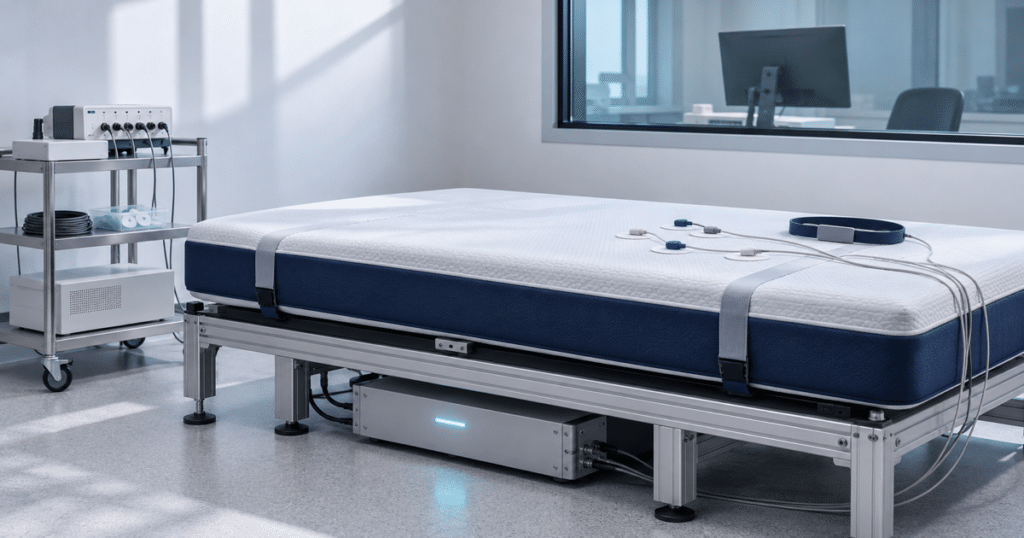
Has a vibrating mattress been shown to clear Alzheimer’s protein from the brain? Not yet. The new vibrating mattress Alzheimer’s study involved healthy adults and a controlled combination of whole-body vibration and the prescription drug nitroglycerin. It was followed by changes in brain-fluid imaging and higher blood levels of soluble proteins including amyloid beta. The pattern was consistent with proteins moving towards the bloodstream, but the study did not show that brain plaques were removed, memory improved or Alzheimer’s disease was prevented or treated.
The research attracted attention after New Scientist reported it under the headline “Vibrating mattress helps clear Alzheimer’s protein from the brain”. The underlying paper was published in Nature Communications on 3 November 2026. This article explains what the researchers actually tested, what they found and why the result remains early-stage.
Evidence checked: 4 November 2026. The account below is based primarily on the peer-reviewed research paper, with the New Scientist report and University of Oulu research summary included as secondary sources.
The study at a glance
- Participants: 29 healthy adults aged 27 to 61, with an average age of 44.
- Combined intervention: 26 participants completed a session combining sublingual nitroglycerin with specialised whole-body vibration.
- Vibration: a commercial research mattress delivered a modulated 22 to 50 Hz stimulus for about 37 minutes.
- Drug: participants received two 0.5 mg doses of nitroglycerin, which releases nitric oxide and dilates blood vessels.
- Measurements: blood biomarkers, blood pressure, MRI and several methods for monitoring brain pulsations and fluid-related changes.
- Important context: participants were awake. This was not an overnight sleep study and it did not test people with Alzheimer’s disease.
What did the researchers find?
After the combined nitroglycerin and vibration session, blood concentrations of amyloid beta 40, amyloid beta 42 and a brain-derived protein called GFAP were higher than they had been before the session. After correcting for blood dilution, the average amyloid beta measurements rose by roughly one third.
The size of the increase was related to the fall in blood pressure caused by nitroglycerin. MRI measurements also changed in ways that the researchers interpreted as being consistent with altered brain-fluid movement and a temporary redistribution of soluble proteins towards the circulation.
Two larger proteins, neurofilament light and phosphorylated tau 181, did not show a significant change. The researchers suggested that molecular size may influence which substances can move through the pathways affected by the intervention.
Why amyloid beta matters
Amyloid beta is a naturally occurring protein fragment. In Alzheimer’s disease, abnormal forms can accumulate and form plaques in the brain. Researchers are therefore interested in how the brain produces, moves and removes soluble amyloid beta before it becomes part of a deposit.
However, a short-term rise in amyloid beta in the blood is not the same as proving that plaques have been cleared from the brain. The study did not use amyloid PET scans to measure plaque burden before and after treatment, and it did not follow participants long enough to determine whether the intervention produced a lasting reduction in brain amyloid.
What is the brain’s waste-clearance system?
The brain is surrounded by cerebrospinal fluid. Fluid movement around brain tissue and blood vessels is thought to help transport soluble waste products away from the brain. This network is often described as the glymphatic system, although scientists are still working out exactly how the different routes operate in humans.
Sleep is relevant because brain pulsations, slow-wave activity and fluid movement change across the sleep-wake cycle. A separate 2026 human crossover study found that normal sleep was associated with higher morning blood levels of amyloid beta and tau than sleep deprivation, a pattern consistent with increased overnight movement from the brain into the blood.
The new mattress study tried to influence some of the same physical drivers while participants were awake. Nitroglycerin widened blood vessels and lowered blood pressure. The modulated vibration was designed to stimulate Piezo1, a protein that helps cells respond to mechanical force. The researchers proposed that these two effects together altered the pressures and pulsations involved in brain-fluid transport.
Why the mattress was only part of the intervention
The headline can make the research sound like a test of a vibrating bed on its own. It was not. The main blood-biomarker finding followed a combined intervention involving both a specialised vibration device and prescription nitroglycerin.
Participants completed the vibration-only and combined sessions in a randomised order, separated by at least seven days. A smaller group also completed a nitroglycerin-only session, while a separate group of 13 people completed a sham resting session for an exploratory MRI comparison. The headline blood-protein result was based on measurements taken before and after the combined session, not a direct placebo-controlled comparison showing that vibration alone cleared amyloid.
This distinction matters for consumers. The study does not show that massage beds, adjustable beds, vibrating mattress toppers or an ordinary mattress produce the same biological effect.
What the study does not prove
- It does not show that vibration prevents, slows or treats Alzheimer’s disease.
- It does not show that brain plaques were removed.
- It does not show an improvement in memory, thinking or everyday function.
- It does not show that a normal vibrating mattress has the same effect.
- It does not establish the long-term safety or benefit of repeated sessions.
- It does not show that vibration during sleep is beneficial. Participants were awake.
The trial was small and short. It involved healthy volunteers rather than people with mild cognitive impairment or Alzheimer’s disease. Blood proteins were measured at one main post-treatment time point, about 90 minutes after nitroglycerin was given. A temporary rise in the blood may indicate movement out of the brain, but it does not demonstrate where the proteins went next or whether total brain levels fell.
Was the intervention safe?
There were no serious adverse events in this controlled experiment. Four participants reported a headache and three reported nausea after nitroglycerin. One participant stopped because of vomiting. The symptoms resolved during the observation period.
Nitroglycerin is a prescription medicine that can lower blood pressure and interact with other drugs. Nobody should take it or attempt to reproduce this protocol without medical supervision. The study is not a do-it-yourself sleep or brain-health recommendation.
What should consumers take from the news?
The result is scientifically interesting because it shows that human brain-fluid dynamics and circulating brain-derived proteins can change after a carefully controlled vascular and mechanical intervention. It gives researchers a reason to test the idea in larger, properly controlled trials.
It is not a reason to buy a vibrating mattress to protect against dementia. The NHS states that there is currently no certain way to prevent Alzheimer’s disease and no cure. Established advice focuses on managing cardiovascular risk, including exercise, not smoking, keeping alcohol within recommended limits and having blood pressure checked and controlled.
A suitable mattress can support comfort and a consistent opportunity for sleep. It cannot be claimed to clear amyloid, prevent dementia or replace medical assessment and treatment.
Frequently asked questions
Did the vibrating mattress clear amyloid plaques?
No. The study measured short-term blood biomarkers and brain-fluid imaging. It did not measure a reduction in amyloid plaques.
Was the mattress tested on people with Alzheimer’s disease?
No. The 29 participants were healthy adults aged 27 to 61. The study did not test symptoms or disease progression.
Did vibration alone produce the main result?
The headline biomarker result followed the combined vibration and nitroglycerin intervention. The paper does not establish that vibration alone produced the same increase in blood amyloid beta.
Were the participants asleep?
No. The study protocol describes participants as awake during data collection. The research was inspired partly by fluid movements associated with sleep, but it did not test vibration during sleep.
Should I use a vibrating mattress for brain health?
There is not enough evidence to recommend one for preventing or treating Alzheimer’s disease. Speak to a healthcare professional if you are worried about memory changes or dementia risk.
The takeaway
A small human study found short-term changes consistent with increased movement of soluble brain-derived proteins after a specialised vibration mattress was combined with nitroglycerin. That is a promising research signal, not proof that a mattress clears Alzheimer’s plaques or protects memory. Larger controlled studies in the relevant patient groups are needed before the finding can become health advice.
Sources and further reading
- Tuunanen J, Hautamäki K, Väyrynen T, et al. Vasomechanic treatment is associated with increased efflux of human brain proteins. Nature Communications. Published 3 November 2026. DOI: 10.1038/s41467-026-78894-y. Read the peer-reviewed study.
- New Scientist. Vibrating mattress helps clear Alzheimer’s protein from the brain. Published 3 November 2026. Read the original news report.
- University of Oulu. Treatment developed by University of Oulu researchers boosts brain clearance and opens up new possibilities for preventing neurodegenerative diseases. Published 3 November 2026. Read the university research summary.
- VandeWeerd C, et al. The glymphatic system clears amyloid beta and tau from brain to plasma in humans. Nature Communications. 2026;17:715. Read the human sleep and glymphatic study.
- NHS. Alzheimer’s disease: Prevention. Read NHS prevention guidance.
- NHS. Alzheimer’s disease: Treatment. Read NHS treatment guidance.
This article is for general information only and is not a substitute for medical advice, diagnosis or treatment.